Tuesday, March 20, 2012

Hate Eternal - Fury and Flames


My first exposure to Hate Eternal came during the first half of high school. Me and my friend Jimmy were exchanging death metal CD's for Christmas - I gave him Deicide's Legion and he got me Suffocation's Effigy of the Forgotten. I think I gave him a second CD as well. I had also planned to give him the newest release by Hate Eternal, King of All Kings. But once I realized that the exchange would be uneven, I jettisoned the Christmas spirit and kept it for myself. Despite only sort of liking the album, when I, Monarch came out I impulsively bought it as well. Although I thought that the guitar work was relatively interesting, the constant blast beats throughout both CD's eventually convinced me that it was boring one-dimensional music, and I sold them off a few years back.

In retrospect, I think my previous opposition to the blasting style of the albums was a little dogmatic. For sure, it's not the type of thing you want to listen to all the time. But in my high school frame of mind, the adoption of blastbeats throughout an entire album was an indication that the band lacked creativity. These days I'm a lot more sympathetic to singularity of vision.

It may seem like a strange comparison to make, but I'm reminded of my first exposure to John Cage's music, which came in the form of the piano collection "In a Landscape" which I bought last fall. Much of the album consists of repetitive piano lines which are simplistic to the point of sounding amateurish or childlike. At first it was easy to see Cage as a cynical opportunist in an "Emperor's New Clothes" scenario, but I soon came to appreciate the stubborn commitment to simple, elemental melodies. To force the listener to reevaluate musical dictums, It takes a musician with a single-minded focus and a willingness to offend our sensibilities.

I guess that's a really pretentious way to say that I love blastbeats and I can listen to them for 40 minutes straight.

In all seriousness, the adoption of the blastbeat as the primary rhythmic backbone is a natural progression for extreme metal, and it's something that happened a lot sooner in black metal because of the de-emphasis on rhythm and the ability to treat the blasting drums as an atmospheric element. But in death metal, I don't think there's anyone who competently explored the idea until Erik Rutan. Revisiting I, Monarch with this perspective, I can finally appreciate the layering of Derek Roddy's steady blasting with delicate cymbal work as a musical subversion of positive and negative space.

That said, on Fury and Flames, newcomer Jade Simonetto's playing is somewhat more varied than Roddy's anyway. But along with the dense layering of three or more guitar tracks at once, the album becomes nothing short of a wall of sound. Apparently it has received criticism in the metal world for that very reason, but in my view such an aesthetic is completely in keeping with the tenants of death metal. Close listening reveals rich compositions with polyphonic guitar and bass lines, and an ear for melody and dissonance which has always characterized Rutan's work.  But on the whole it's aggressive and nearly impenetrable by design.  

The relentless technicality, oppressive atmosphere, and general disdain for subtlety and restraint make Hate Eternal unquestionably a band of the 2000's. Particularly in the drumming category, the music-as-athletics approach simply didn't exist in the old school days. But despite all of this, Rutan's playing and writing style retains a connection to traditional death metal that many modern bands don't. I think the thrash leanings of Rutan's early career in Ripping Corpse are still with the band to an extent. While percussive rhythms and intentionally amelodic note choice dominate much of the material from bands like Origin and Nile, Rutan's riffs seem largely informed by his unique melodic inclinations.

On a more aesthetic level, I'm a huge fan of the sound on this album. For one thing, Fury and Flames has one of the most prominent bass sounds I've heard on a death metal album. Although it apparently goes against common practice, sacrificing a little bulk in the guitar tone to give more presence to the bass adds a whole level of sonic depth in my view. That's a big part of a reason why I'm such a big fan of the early Cryptopsy albums. In addition, the guitar tone may not be as sharp and punchy as is typical, but it gives an almost doomy flavor to a lot of the low register, backing guitar lines.

For such an unrelentingly dense album, the songs are impressively diverse. There's the melodic thrashing of "Whom Gods May Destroy:", the dissonant trudging of "Fury Within", or the staccato rhythms of "Thus Salvation". The emotionally tinged playing of "Tombeau (Le Tombeau de la Fureur et des Flammes)" is particularly noteworthy - Rutan's tribute to a deceased bandmate and friend displays a vulnerability rarely heard in this genre.

In short, I'm completely blown away by this album and it's driven me to re-purchase those two Hate Eternal albums that I discarded a few years back. I was always attracted to Rutan's guitar work, but I've finally warmed up to his challenging and dense take on the genre as a whole. It's risky to make broad statements after owning an album for a week, but I feel fairly certain that Fury and Flames has joined the ranks of my favorite post-2000 metal albums.

Saturday, February 25, 2012

Wu-Tang Clan - Enter the Wu-Tang (36 Chambers)


As 2011 came to a close, I felt happy that the year had brought a significant expansion to my musical taste; a newfound appreciation of jazz.  So just before the new year I was asking myself what type of music I should try to get into for 2012. I was thinking about classical or electronic music. It goes to show how stupid it is to try to plan these things out, because within a couple weeks I had gotten onto a hip hop binge that has lasted for a month and a half by now. I certainly wasn't anticipating that at all.


Truthfully, my foray into hip hop wasn't completely unprecedented - a year or two ago I was listening to Aesop Rock's Labor Days and a couple others, and got kind of into it, but not enough to buy any albums. I actually tried to get into 36 Chambers at the time, since I knew it was considered a classic. I couldn't get past the first couple songs though. The first track, aptly named "Bring da Ruckus," contains the chorus "Bring da mother, bring da motherfuckin ruckus, bring da motherfuckin ruckus", which seemed kind of tacky. The second track, "Shame on a Nigga", succeeded in offending my cultural sensibilities with its gratuitous use of a word which I'm pretty sure I'm not supposed to type without an asterisk.


Well, last month I got curious about hip hop again. In my continuing quest for behavioral consistency, I reminded myself that I already listen to horrifically offensive albums (like Cannibal Corpse's Butchered at Birth), horrifically stupid albums (pick something by Rhapsody), and albums by people who I'm - hopefully - just as culturally removed from as inner city blacks from the early 90's (pick something by Burzum).


The other psychological stumbling block was the general idea of being a white male listening to hip hop. But that can't possibly be worse than being an affluent and well educated white male listening to Kind of Blue while in possession of a french press, and I already went there. These realizations were basically all it took to rid me of my squeamishness so I could dive into one of the most infectious and visceral albums I've heard in a long time.


In retrospect, it's hard to understand how I could have listened to the opening track of this album and registered little more than the chorus. In a way, it has all the makings of a song I would love - aggressive, almost sinister tone, intricate layers of sound, musical complexity on the small scale without sacrificing an overall coherence and simplicity to the song itself.


This album seems particularly suited for a newcomer to the genre since it's evenly split between 7 rappers (there are 9 in the group but a couple of them don't do much on this album). The variation keeps things interesting at first, and for me it was kind of an activity to try to figure out whose verse was whose. 


Ol' Dirty Bastard is the most immediately recognizable of the bunch, and his inclusion of assorted grunts and wails initially attracted me. His style works well in the context of the album, but as time goes on I feel less interested in listening to his solo stuff (which I haven't heard yet). Method Man and Ghostface Killah are the next most distinctive of the bunch, so it's probably not surprising that theirs are the most well known names. But the stuff from Raekwon, Inspectah Deck, GZA and RZA (who also does all the production) is equally good if not better. GZA is definitely my favorite, but I'm a little biased because his stellar Liquid Swords is the only solo album I've listened to so far.


Right now it's a little hard for me to judge how I'm going to feel about the album after time passes. There hasn't been an album in a very long time which I've listened to this many times within the first few weeks of hearing it. That surely says something about it's quality, but when I was listening to this last night the appeal wasn't as strong. It's mostly that I'm burnt out on the album at the moment, but I've also gotten into several more hip hop albums in the last few weeks. In comparison, this seems a little bit more like a party album. Liquid Swords contains almost the exact same line up, but the tone of the album is largely dark and brooding, and the rappers alter their delivery to suit it. 


Overall, it's easy to see why 36 Chambers gets the "classic" tag, and it did a good job of intiating me into the world of hip hop. In a way I surprised myself with this development, but I guess it's a lot less surprising than if I were to suddenly get into country. And even that seems more likely than a sudden embrace of indie. I've come to realize that there is great music in virtually every genre, and it's just a matter of seeking it out and being mentally ready to hear what it has to offer. In that sense it seems necessarily true that the progression of my taste is dictated by extra-musical factors. At times like this I wonder why I had to think so hard to arrive at such an obvious conclusion.


Monday, January 16, 2012

Nurse with Wound - Rock 'n Roll Station

At various points during my music-listening career, I have gotten quasi-obsessed with the idea of a certain band or artist without having developed any deep affection for a particular album or work. John Zorn and Merzbow come to mind. Thankfully I only got two Zorn albums before losing interest, but I nearly ended up with a massive box set of his avante-garde and potentially unlistenable "Game Pieces" - I went so far as bidding on it on Ebay. With Merzbow I downloaded a couple albums and really liked it, and then bought 3 albums in close succession (and nearly a fourth as well; its out-of-print nature a temptation). Since then I haven't found one occasion to listen to Merzbow for longer than 5 minutes.

When I started this blog I was just getting into Nurse with Wound. I was intrigued by what I had heard, and even more so what I had read about their vast discography. Concurrently, I discovered Amazon's (awesome) textbook buyback program, and traded in a stack of books with the intention of immediately spending a sizable chunk of my $225 haul on NWW releases, including the 3-CD ambient box Soliloquy for Lilith. In the weeks between mailing the books and receiving the money, my enthusiasm cooled a bit and I didn't follow through. For several months after, I regarded that as another very-close-call with impulsive purchases of experimental music dust-collectors.

In the last few months I've rediscovered the NWW albums I had, and been surprised to find that they are legitimately becoming one of my favorite "bands" (scare quotes since NWW is basically just Steven Stapleton and whomever he brings along) . If Zorn was the person responsible for making me think experimental music was nothing but pretentious BS for several years, Stapleton is the one responsible for showing me that it can be fun.

The latest addition to my NWW collection is Rock 'n Roll Station. Whereas most NWW falls somewhere between ambience and sound collages, the songs on Rock 'n Roll Station actually have a beat. While the action of each song still lies in subtly shifting atmospherics with punctuated bursts of found-sound and assorted instruments, each is accompanied by a stubbornly repetitive - yet nearly danceable - layer of electronic drums.

I'm told that this uncharacteristic inclusion caused some fans to decry the album as being more "accessible".    

The title track opens the album, and grabbed me as soon as I first heard it. It's a sort of spoken-word poem backed by a catchy beat and various other sounds which skillfully interplay with the vocals. Like all NWW songs containing words, these are absurd, impenetrable, and in my estimation, awesome. The track is responsible for me walking around all week with phrases in my head like "Jack's bicycle is music to my ears" and "Rock 'n roll session is a second pirate session of a strange wax".

Words take a less prominent role on the rest of the tracks, but each finds its own way to be distinctive - from the didgeridoo jam on "Two Golden Microphones" (probably the only example in my collection) to the jangly, fractured guitar riffing of "R+B Through Collis Browne".

With the first couple NWW albums I listened to, I felt intrigued but didn't really understand what the band was all about. Homotopy to Marie and most of Spiral Insana gave me the idea that they were practitioners of purely abstract sound manipulation, but then I was confounded by the appearance of scattered sections of conventionally melodic piano. Then I listened to An Awkward Pause and was confronted by "Two Shaves and a Shine", an unabashed rock-guitar based jam session. Eventually I've come to terms with the fact that NWW isn't really about anything - there's seemingly no limit to what you might be greeted with on one of their albums. The only thing you can count on is a meticulous attention to detail and a tongue-in-cheek attitude that keeps the invariably obscure proceedings grounded and entertaining. Well, relative to Zorn anyway.
  

Friday, April 1, 2011

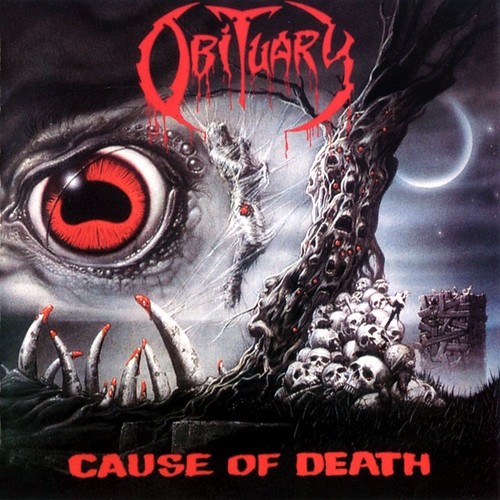
Obituary - Cause of Death


As far as I can remember, Obituary's Cause of Death is the only album in my collection that I intentionally got rid of, and then bought again.  Their World Demise album was one of my very first death metal albums and it was something of a revelation at the time.  The fuzzy guitars, the vocals that sounded like a cross between growling and vomiting.  I remember getting into it in middle school and coming in to tell my friend excitedly.  His response was simple: "I didn't see that one coming".  I think it was obvious that I was heading down the path of brutality.

I eventually picked up this album, since it was without question the most revered Obituary release, and supposedly a death metal classic.  It didn't do much for me though.  In the time between my purchase of World Demise and Cause of Death, I had become a more educated metal fan.  I had discovered Opeth, late period Death, and Meshuggah.  Obituary just seemed totally boring and simplistic.  I think my general sentiment was this: Obituary has one of the greatest vocalists in death metal.  Too bad it's wasted on such boring music.

Flash forward 9 years and I now consider this album one of the essential death metal releases, at least to the point of buying another copy.  In some ways my perception of Cause of Death hasn't really changed that much.  I still think the vocals are the most noteworthy thing about the sound, and I still think the music is fairly standard.  It's just that my values have completely changed.  

For a good six years, the crux of my musical taste evolved according to the notion that metal was a genre that could be just as respectable, artistic, and proficient as any other style of music.  I made forays into other "adventurous" genres of music; I made parallels to other visceral styles.  And somewhere in there I think that the pure feeling of glee at hearing a grown man puke into a microphone was beaten down.

In the last couple years I have apparently come full circle.  In my current estimation, the immediacy of the drumming, the jagged distortion of the guitar, the primal screaming - these things define value in death metal far more than the intricate and analytical progressions of an album like Individual Thought Patterns.  And in that regard Cause of Death has gained considerable ground.  In a phase of life where I wanted metal to withstand the scrutiny of (popular) critical opinion, the vocals could hold no greater status than a superfluous, if amusing, ornament.  But in the sense that death metal's value is derived from its raw intensity, what could be more crucial than throat ripping vocals?  

It's not that I no longer believe in the capability of death metal to be ambitious in scope and musicality.  But to downplay the aesthetic aspect of the music is to ignore the most blatant point of all: nobody listens to this stuff if they don't enjoy, on some level, the sound of musical chaos and aggression.

It’s a natural tendency to want others to respect your musical taste, and I wonder to what extent that drives many people to “grow out” of metal when the capacity to enjoy it never really left.  But maybe what I’m talking about is really just the self-imposed repression of being an adult.  My friend Vinay used to talk about this a lot.   Most people never stop liking many of the things that kids enjoy, like running around outside.  Adults only run around after assigning the behavior a constructive purpose and putting on clothes which signify that the behavior is non-threatening.  How very un-metal.

That was off-topic, but the point is that I think I had to come to terms with the fact that my musical taste is completely unjustifiable to the majority of reasonable adults before I could fully re-immerse myself in the world of unapologetic, zero-crossover appeal death and black metal.  And it’s significant because I truly believe that that’s the form of metal which has the most artistic significance (despite most critics thinking the opposite).  As I’ve alluded to before in this blog, if the value of a work of metal is derived from its crossover elements, then the entire genre becomes the musical equivalent of the WWF – a soap opera with just enough gleaming muscle to achieve male legitimacy.

In retrospect, I think the point when I stopped caring about justifying my musical taste to others coincided pretty closely with the point when I began identifying myself much more with my work.  In the first couple years of college, I know of at least one instance when I verbally referred to myself as a “metalhead who did engineering”.  Needless to say I would never think that way now.

To summarize, Cause of Death is pretty good.

Tuesday, January 18, 2011

Megadeth - Peace Sells...But Who's Buying?


It's safe to say that I was a pretty big Megadeth fan back in high school.  I owned every album they had released, except for Peace Sells...But Who's Buying?, which I only had a burned copy of.  The first album had been remastered in 2001, and somewhere in there I had obtained a copy of both the original and the reissue.  They were easily my favorite band, so in 2004 when Dave Mustaine decided to release remixed and remastered versions of albums #2-#8 (along with MD.45's The Craving), I did what any reasonable fan would do.  I went out and bought all 8 albums the day they came out.  I even saved the receipt for a while as a token of my fanboyism - I think I spent something like $90.  On albums I already had.  (Except for The Craving).  Only the first few really warranted a remaster at all, but the spines of the eight made the face of Vic Rattlehead when you put them together, and it just looks stupid if you only have half of his face sitting there on your bookshelf (exactly the reason why I can never buy Iron Maiden's Powerslave unless it has catalogue number RAW CD 131 - those dudes have released about 10 versions of everything and two of the reissue series have made the face of Eddie, but not compatibly - a fact I wish I knew before I bought Somewhere in Time and totally screwed up the middle of his face).

I guess I don't regret buying the whole set, because it was the ultimate display of my badass metal fandom, but I've since come to the conclusion that the reissues pretty much suck.  From Countdown to Extinction onwards, it doesn't really matter.  The drums are punchier, the tone is thicker, whatever.  But Peace Sells and So Far, So Good...So What! were the pinnacle of 80's thrash.  They were written by a heroine addict who was so drugged out that he got kicked out of Metallica and made his band with the sole intent of being heavier and faster than them.  And I think that general vibe shines through the original albums.  

More generally though, the sound of thrash is intimately tied to late 80's production values.  I hated Testament's First Strike Still Deadly, I hate all 21st century retro thrash, and I hate these remasters.  When you listen to classic thrash albums, I think the hardcore/punk roots are clearly there, and along with it comes a visceral immediacy that made the music so great.  Remaster them 15 years later, and you are layering on aesthetic sensibilities that don't reflect the original era - loud bass, punchy drums - things that accent the thickness and crunch which is characteristic of modern metal and not the blurred out speed of the original sound.  I'm sure it seems counterintuitive, but albums like Peace Sells actually sound more aggressive to me with their original thin production.

But beyond the general points, I think it's problematic to have an artist remixing his own work 15+ years after the fact.  You've got Mustaine sitting their at the knobs, in a phase of his career where he's making crap music which he probably thinks is good, and making "improvements" to his classic work.  I am definitely not one to say that the artist knows best - some of my favorite albums (like None so Vile or Transilvanian Hunger) were almost certainly brilliant despite their creators lack of artistic vision.  Lord Worm said they were drunk the entire recording of NSV, and Fenriz thinks their early material was easy to write and that their current stuff is better music.  Most of the time, metal needs that youthful abandon to be truly definitive, and maturity obviously doesn't do people like Mustaine any favors.  

So the point is, I may not like remasters to start with, but a remix is just blasphemous to me.  Listen to the riff of "The Conjuring" for example, after that shout of "Obey!".  That riff was not all stacatto like that, all the reverb was taken off.  It sounds way crappier to me.  And it's changing history.

It probably sounds like I'm latching on to trivial things out of some irrational commitment to the originals, but that really isn't it, and here's my evidence:  perhaps my favorite metal album of all time, Sepultura's Beneath the Remains.  I left it in my friend's car in high school, and after several weeks I got back the disc, but the case and artwork were gone for good.  I just couldn't have that, so I bought the remaster.  This was a point in my life when I assumed that remasters were always better (exactly the reason that I bought the whole Megadeth set).  For a year or two, I just listened to the remastered BTR, but it never really grabbed me anymore.  It was nothing conscious, I just assumed that I didn't like it as much as I used to.  But after gradually realizing that the Megadeth remasters sucked through side by side comparison, it dawned on me that this was the problem.  I went back to the original BTR, and it returned to its rightful place as one of my favorite albums, and has remained there.

I guess this shows how large a role aesthetics plays for me in thrash metal (and that goes for death and black metal as well).  This wouldn't really help my case if I were trying to convince an outsider of the genre's merit, but it really is true.

Long story short, after 7 years I've filled in the hole in my collection of two-copies-each of the first 8 Megadeth albums.  All because the other day I was listening to the album for the first time in a year or two, for the first time ever on a decent pair of headphones.  It was like hearing it for the first time, and it was amazing.  So I thought what the hell, I'll shell out the $8 for a non-remastered version of one of the best metal CD's ever recorded.  Why not.  It's just a shame that future metal fans will grow up on an inferior version of these classics (and don't even get me started on Rust in Peace - rerecorded vocals, it's too painful for words).  I guess they won't know the difference, but that doesn't make it easier to live with.


P.S.  The new version also deleted the words "Vic Realtors" from the For Sale sign on the cover.  Sure it was cheesy, but it's history!  You can't rewrite it!

Friday, December 17, 2010

Samael - Ceremony of Opposites


I've had Ceremony of Opposites for a long time.  This is a relic of the good old days when I would walk to the mall with friends and buy any album I could find by a metal band I had vaguely heard of.  Most of those albums have been sold on ebay by now, but a few turned out to be pretty good.  And nearly 10 years later, when I finally got into black metal, this one turned out to be one of the best.

Most of my blog posts are about albums which I've only recently heard.  But this post was inspired by a particular memory of my middle school life.  As soon as I put this album on, I am brought back to the guest bedroom at my grandmother's house.  It was one particular time, I was staying there and listening to this album.  It just stuck with me unexplicably.  That happens occasionally - I also have a memory of one particular Napalm Death cd which I was listening to at one particular intersection in Maine.  Weird how that works.

It seems pretty ridiculous that I own an album which depicts Jesus bleeding from his skull, and I associate it with sleeping at my grandmother's house.  Clearly this is the album responsible for my atheism.  Actually, at the time that I bought this, I was still heavily influenced by my Catholic upbringing.  One of the last songs had the lyrics "I spit at your god's face, I piss on the cross, I vomit on the holy bible, I shit on the blessed whore and her bastard son".  I was legitimately traumatized.  I think it turned me off of the album for a while.

I don't know what I'm trying to say here.  I've been drinking a little bit and I don't feel like writing this anymore.  The album fucking owns.  Ben and Antonia should listen to it.  The end.

Thursday, November 25, 2010

Agalloch - Marrow of the Spirit


A letter from John to the Beninthians:

Before hearing this, the idea of a new Agalloch CD held a similar status in my mind to a new Katatonia CD.  I expected it to be a proficient example of modern, melodic, arguably overproduced metal.  Something that I would get a lot of enjoyment out of listening to for the first several spins, but which I would ultimately view as little more than the metal version of a pop album.  As much as I enjoy Ashes Against the Grain or Night is the New Day every time I listen to either of them, I don't sense much ambition in the music beyond being metallic ear-porn.  So I wasn't even in a hurry to download Marrow of the Spirit when it first leaked, and the decidedly mixed reactions I read online only supported my prejudice.

Luckily I was wrong about this thing.

From the opening drum roll of "Into the Painted Grey", this album took me by surprise.  If there was one word that came to mind to describe that opening, it was the word "awkward".  The timing seemed just plain wrong - and in a completely superficial way, I loved it.  Like every other crossover death or black metal band to use clean vocals and acoustic guitars in the last 10 years, Agalloch has garnered their share of Opeth comparisons.  But the unapologetic stream of blastbeats that followed had me thinking more about Darkthrone.  And that's the last thing I thought would happen.

Regardless of its role in the unfolding of metal history in 2010, I think I would find Marrow of the Spirit to be an enjoyable album.  Yet I've noticed an unintentional running theme of Opeth bashing in my blog, and my one reader may have noticed it as well.  In the same way that Opeth is coming to symbolize the destruction of extreme metal in my narrative, Marrow is the Messiah.  In the early 90's, they were working alongside my other favorites like Dark Tranquillity and Amorphis to take the death metal template and expand it into something that could transcend the genre, while retaining its original spirit.  And we were graced with classics like My Arms, Your Hearse, The Gallery, and Tales from the Thousand Lakes.  But for nearly 10 years now, all of these bands have been churning out increasingly streamlined, proficient, and perhaps worst of all, critically acclaimed albums.

The problem with critical acclaim is that, while these bands have (to varying degrees) ostensibly brought some legitimacy to the genre, they sacrifice the immediacy and aggression that were initially its hallmark.  I remember one significant moment when I played Immortal's Battles in the North for an indie-listening friend.  He seemed shocked to hear the unapologetic, sloppy fury coming out of my speakers.  A (no doubt well intentioned) metal-listening friend had convinced him that metal was essentially beautiful music, but distorted.

Isn't that what all of these recent Opeth albums are about after all?  Beautiful music, distorted?  That's fine in its place, but it's worrying to think that this could be the only form of metal with any lasting critical or popular recognition.  A style of music which is just like "normal", but with distortion, seems like the definition of a superficial and useless style.  If extreme metal has any significance at all, it's because its fundamental rejection of popular notions of taste, melody, and structure are philosophically sound - not simple stylistic trappings to be shed away with maturity.  Or as Napalm Death said on the most commercial album of their career, Words from the Exit Wound:  "If maturity wipes the slate carefree, keep me infantile".


So, the point of that long-winded, self-indulgent blog post is that Agalloch has taken their position as critical-darlings of post-metal, and used it to affirm a lot of the things that I love about black metal.  A drummer that uses exhausting, tasteless blast sessions and awkwardly jagged fills as a stylistic device to preserve the immediacy of the music while displaying just enough proficiency to signify that he's doing it on purpose.  An organic production that celebrates natural distortion and noise instead of compressing everything into a synthetic, lifeless block.   

To me, Marrow of the Spirit is easily the most dynamic thing that Agalloch has done, and hopefully it will convince some people that metal is more than just normal music, mandated by testosterone to sound like cookie monster.